
Using AI For Discovery Calls
Discovery calls are such a critical step in any sales process. Potential buyers can make quick judgements on you and your offering.
There are many approaches to discovery in terms of tactics, how to prepare, how to ask good questions, how to set next steps, and lots more. AI can play a significant role in supporting your discovery calls.
AI is strongest when you give it context, direction and your own judgement. The quality of what you get from AI is heavily influenced by the quality of the thinking you bring to it.
Here are three areas you can guide AI to have an impact in your day-to-day sales work:
Research and POV building
Post call analysis
Refining your sales skills
Remember that AI isn’t a fixed entity. What’s available for you to use at your company and how its capabilities change over time is out of your control. This means your focus should always be on how to guide AI.
💡 Step Up Sales Principle
The capabilities of AI will continue to evolve, and so will your usage, but the underpinning sales principles should come from you.
1) Research and POV building
AI is great for research at pace and depth. It can find, read and highlight key aspects of an annual report in just a few seconds. It can do this across multiple sources and content types. Before AI this work, done well, would take a salesperson a few hours.
The danger is that you gather a huge amount of information, but no insight. Ultimately your goal is to have knowledge to apply to your call, not for the sake of gathering it. One page of relevant insights is way better than 20 pages of general information.
So, you need to build a structure for it to follow based on your role/industry - what information you want to know and in what format? It can then execute that quickly. Here is an example: simplified from a version I use in my current role:
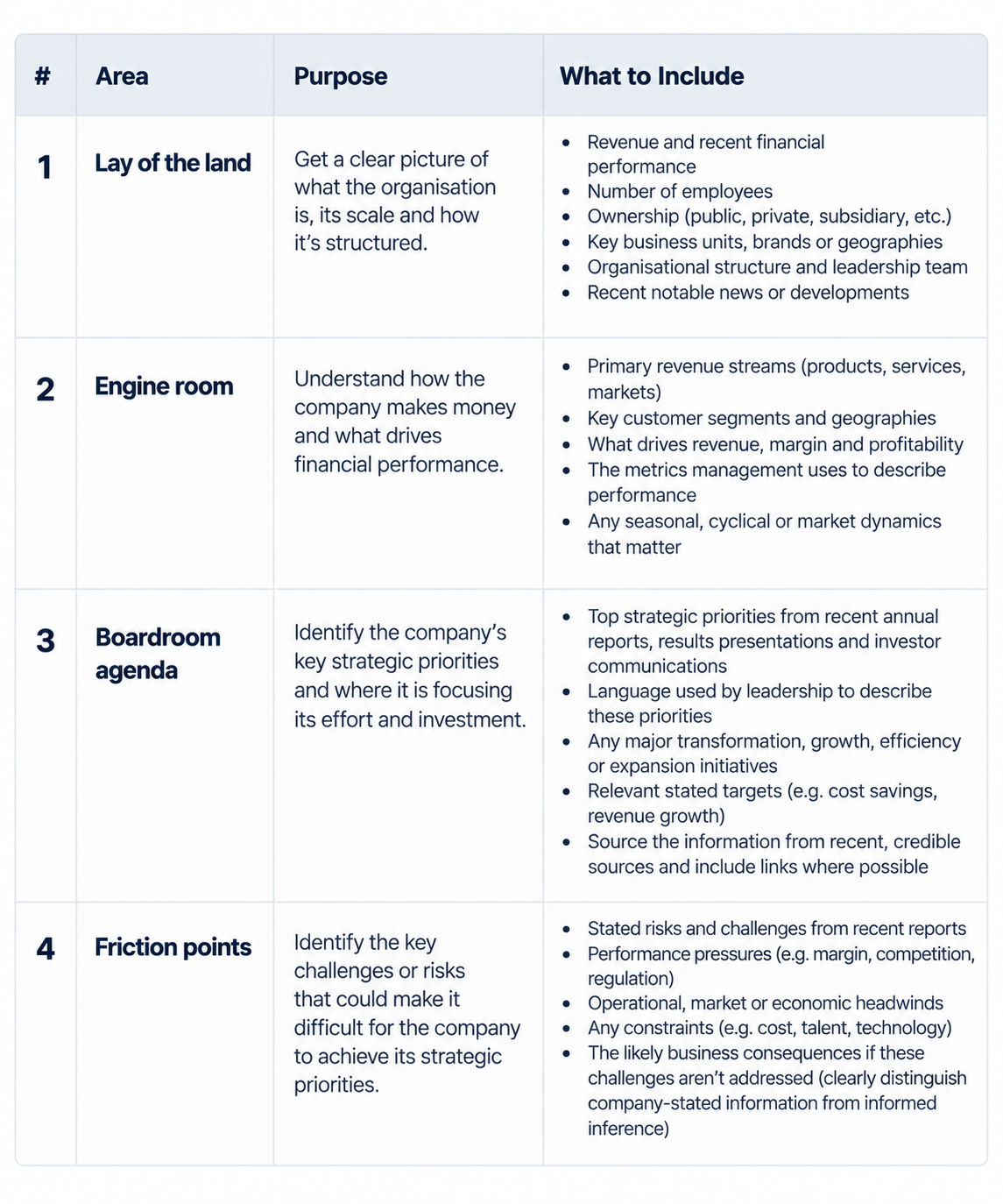
The idea is that I uncover core facts and figures to support my general understanding of the company, then move towards potential pains/issues/objectives within the company right now.
The plan would then be to prompt the AI further on certain topics of relevance. Maybe it brings me some information from an annual report that a company is on a cost-saving initiative, looking to save "£300m over 5 years”. I might then ask AI more about this until I build a perspective that I want to discuss on the call.
“When AI provides the base research, use your judgement to question it further on certain areas of interest for deeper understanding”
Example:
Let’s say you are selling a platform that helps efficiency in supply chains. You are targeting Sainsbury’s - the grocery retailer listed in the FTSE 100.
The base research with AI uncovers that they are in a "£1bn cost saving plan through to 2027 as part of the Next Level Sainsbury’s strategy" (from 2025 Annual Report). This is a great board-level initiative that you might want to attach your solution to.
Now you can use AI to go a bit deeper to find more - What's driving the programme? Where are they expecting the savings to come from? What has leadership said about it? What other strategic priorities does it connect to? What is the relevance of this for their supply chain (relevant for this example)?
Use your judgement to guide the AI on going deeper into the topics you know are most closely linked to the outcomes your solution can support.
Doing this type of deeper research helps me build my first POV to bring to the prospect, alongside a set of questions/topics I want to discuss on the call.
Remember that whilst a discovery call is an opportunity for you to uncover relevant information from a prospect, you want to bring some value to them. Being able to have an informed idea around “this is why we are talking, this is what I think is a challenge, and this is an outcome we could get you to”, will show the prospect that you have come prepared for a valuable 2-way conversation.
✅ Exercise - Going beyond base research with AI
1 - Conduct initial account research using AI, based on your own process or my example template above. From the output provided by AI, identify two pieces of information that you think are most relevant for your discovery call.
2 - For each one, ask AI 2-3 follow-up questions. For example:
Why might this be a priority for the business?
What has the company said publicly about this?
Which teams or executives are likely to care about it?
What could be driving this initiative?
Is there anything in its annual report or earnings calls that gives me more context?
3 - Turn your research into a discovery theme. For each area, summarise what you've learnt into one topic you think is worth exploring with the prospect. Then write your initial POV and 2–3 questions that will help you understand whether it is actually relevant to them, why it matters, and what impact it is having.
The aim isn't to prove your research is right. It's to use what you've learnt to form a better starting point for the conversation.
The purpose of this research is to make you as informed as possible, whilst doing so in an efficient way.
But this doesn’t stop after the first call. Something to consider is that discovery continues throughout the sales process. In enterprise sales motions, you may end up speaking to 10s of people at different stages. You need to keep refining/updating your POV as you progress through the process and meet new stakeholders.
This is where analysing your calls afterwards for valuable information is key, and AI can play a helpful role in this.
2) Post Call Analysis
Most if not all sales teams have access to call recording and notetaking tools now. These may include AI capabilities for creating summaries, assessing against MEDDICC or other sales qualification methods, running gap analysis, and so on.
At a minimum, these are great for updating CRM notes and guiding you on next steps. There are some good time savings to be had with this.
However, we can do more with this information.
“AI becomes more valuable after discovery when you use it to build and refine your understanding of the opportunity - not just to summarise the call.”
This is particularly true the more complex a sales process. Imagine that over several discovery calls and meetings with different stakeholders you are preparing for an important pitch to leadership.
Whilst you should have built some good understanding of your prospect yourself, AI can support bringing together all the information into a refined PoV that becomes highly relevant.
It may be you can do much of this multi-call analysis in the recording tool itself. Or that you need to manually bring together your call transcripts and initial research into another AI tool. Maybe you already have an advanced setup that pulls all notes, research and CRM data into a single place automatically.
The “how” you do this and the capabilities of AI will continue to change depending on company and tech - and you can only work with what your company provides (don’t put work related content into your own AI - it’s likely against company policies). Instead, keep these principles in mind for post-call analysis to get the most from it, whatever the tools you have:
Analysis is the biggest opportunity vs note-taking/summaries. Take the transcript and put it alongside the research and POV you developed before the call. Now AI has both what you thought might matter and what the customer actually told you.
Use it to challenge and refine your understanding. What did we validate? What assumptions were wrong? What new pains/outcomes emerged? Where did I make a leap without enough evidence? What did the customer say that deserves more attention? As mentioned earlier in the article, the real skill is to guide AI and you should use this as an oppportunity to work on this.
Compound the benefit by assessing multiple calls. I'd always look for opportunities to use AI for connected analysis across multiple calls, rather than drawing conclusions from each call in isolation. AI can help you see patterns, contradictions, gaps, and how the opportunity is evolving.
Validate with your own judgement. AI might identify something as a major pain because it was mentioned repeatedly, but you may know from the nuances of conversation that it wasn't particularly important. Its analysis is another input into your thinking, not for you to follow blindly.
If you can guide AI to do the things that are both hard for you to do and to help understand a prospect/opportunity, this will put you in a much stronger position across all your deals.
3) Refining Your Sales Skills
In using AI to analyse your calls, you’ll start uncovering gaps in the way you do things. Maybe you keep identifying a relevant and important pain, without then going deeper into impact.
As such, an underrated use of AI is in coaching. There are two ways I’d start with this:
Sales Best Practice: Based on the gaps in your work identified by AI (or that you know you want to improve), ask it to coach you on how you could have approached it better. You could even take the calls from other top sales reps and use AI to see what they did well and compare it to yours.
Persona Role Play: Ahead of a discovery call or future pitch, you could use AI to help practice. You can give AI a role/persona alongside your research notes and discovery call transcripts. Set the scene of the meeting and you can run a mock-call (often over a voice chat if your AI tool provides this feature). A really simple example would be asking AI to take the role of a senior buyer in your deal, say a CFO, then you can practice that conversation.
“Ultimately, the real coaching opportunity with AI isn’t just getting it to identify where you could improve. It’s using it to understand those gaps, and then practice doing something differently before your next call.”
As with everything above though, you still need to guide it. Give it the context, tell it what you're trying to improve, and apply your own judgement to what comes back.
📌Key Takeaways
AI can increase the speed and depth of your work, but more information doesn't necessarily mean more insight. Guide it towards what actually matters for the conversation.
Use AI to continually refine your understanding. Combine your initial research with what you later learn from the prospect as the opportunity develops.
AI should support your sales judgement, not replace it. You decide what matters. Use it to complement how you think and sell.
Recently made a step up?
I occasionally help salespeople who are finding their feet in a new role, free of charge in my spare time. If you'd value an experienced second perspective on where to focus, get in touch.